
Co-Author: Ed Smeloff, Gridlab Expert
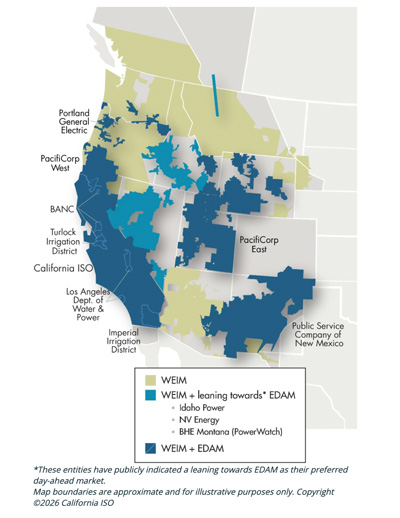 The launch of the Extended Day-Ahead Market (EDAM) and Day-Ahead Market Enhancements (DAME) on May 1, 2026 has notably altered how the available mix of energy resources is used by the CAISO to meet its electric load as the balancing authority for much of California. Since the launch, PacifiCorp East and West have been participating in the CAISO-managed day-ahead electricity market for a geographical footprint that includes approximately one-third of the electric load in the Western United States.
Because regional resource optimization now occurs at the day-ahead level rather than just in real-time (as was the case with the Western Energy Imbalance Market, or EIM), CAISO is using its fleet of gas-fired power plants at a significantly lower level. In fact, California gas-fired generation has fallen to historic lows during mid-day hours and much lower during the evening ramp. This dramatic shift is due in part because of the new market for imbalance reserves that the CAISO has implemented through DAME.
Internal EDAM Area Transfers
A major shift in California’s energy dispatch comes through the sharing of resources with PacificCorp East and West. Each day the three balancing areas are required to show the resources that are available to meet the Resource Sufficiency Evaluation tests and which can be co-optimized in the day-ahead markets for energy, ancillary services and imbalance reserves.
- Resource Composition: These day-ahead resources include large quantities of regional renewable resources, including hydroelectric plants. During the mid-day, significant amounts of solar and wind energy is available across the western footprint to serve CAISO and PacifiCorp East and West load. The combined clean energy resources help displace the need for California-based fossil resources to be committed in the Integrated Forward Market (IFM).
- How DAME Enables Better Optimization: Before May 2026, CAISO had to commit many local gas plants a day ahead in order to cover uncertainties associated with assuring sufficient flexible resources were available for the evening ramp. Under DAME, the new Imbalance Reserve Up (IRU) product allows CAISO to secure evening ramping flexibility across the expanded market footprint without requiring as many California-based gas plants to physically turn on and spin at their minimum operating levels earlier during the day so they can ramp up to meet the net evening peak.
- The Role of SunZia: The SunZia project is the first major new out-of-state energy resource to participate in the new market framework. Operating through multiple Power Purchase Agreements (PPAs) with California load serving entities, its 3000 MW of generation is delivered over a dedicated 525 kV high-voltage direct current (HVDC) transmission line. Because it terminates directly at a CAISO interconnection point, its energy is scheduled into day-ahead markets.
Dynamic Flexibility & Imbalance Reserves
DAME now optimizes flexible imports and internal CAISO resources to manage day-ahead forecast uncertainty, creating new market opportunities for renewable and battery storage resources. A diverse mix of battery storage systems (BESS), hydroelectric capacity, flexible natural gas peakers, and advanced renewable projects like SunZia now participate in the imbalance reserves market.
CAISO procures daily Imbalance Reserve Down (IRD) and Imbalance Reserve Up (IRU) across the entire expanded footprint. When CAISO calls on these reserves, they provide “headroom” or “footroom” that can be adjusted dynamically in either direction. Because a battery or hydroelectric resource can hold an IRU award without burning fuel or producing energy during the mid-day, CAISO can meet much of its midday energy from renewables while using these imbalance reserve assets as flexible backup resources.
Variable energy resources now provide over 80% of the Imbalance Reserve Down (IRD) product. SunZia stands out as an exceptional resource for IRD for several reasons:
- Instantaneous Electrical Response: Utilizing a controllable HVDC converter, SunZia can curtail its power flow almost instantaneously without the mechanical stress or cycling costs associated with thermal generators.
- Financial Mitigation Against Mid-Day Oversupply: During solar-producing mid-day hours when CAISO wholesale energy prices can drop into negative territory, a wind project that clears the IRD market obtains a capacity reservation payment. This supports the project’s overall revenue.
- PTC and PPA Protection: Because the underlying wind project benefits from federal Production Tax Credits (PTCs) and “as-delivered” PPA structures with California load-serving entities, its Scheduling Coordinators can use negative economic energy bidding curves to optimize its dispatch. By offering downward flexibility, SunZia can secure revenues from CAISO while ensuring its generation is only backed down when necessary to balance real-time grid deviations.
GridLab Analysis of Resource Dispatch
GridLab has conducted an examination of the mix of resources dispatched in the CAISO balancing area for two similar June days – one in 2025 before EDAM, DAME and SunZia; and a second in 2026 after these changes were put in place. In addition to the new markets and additional wind, CAISO also added 1.7 GW of solar and 3.6 GW of batteries in the past year.
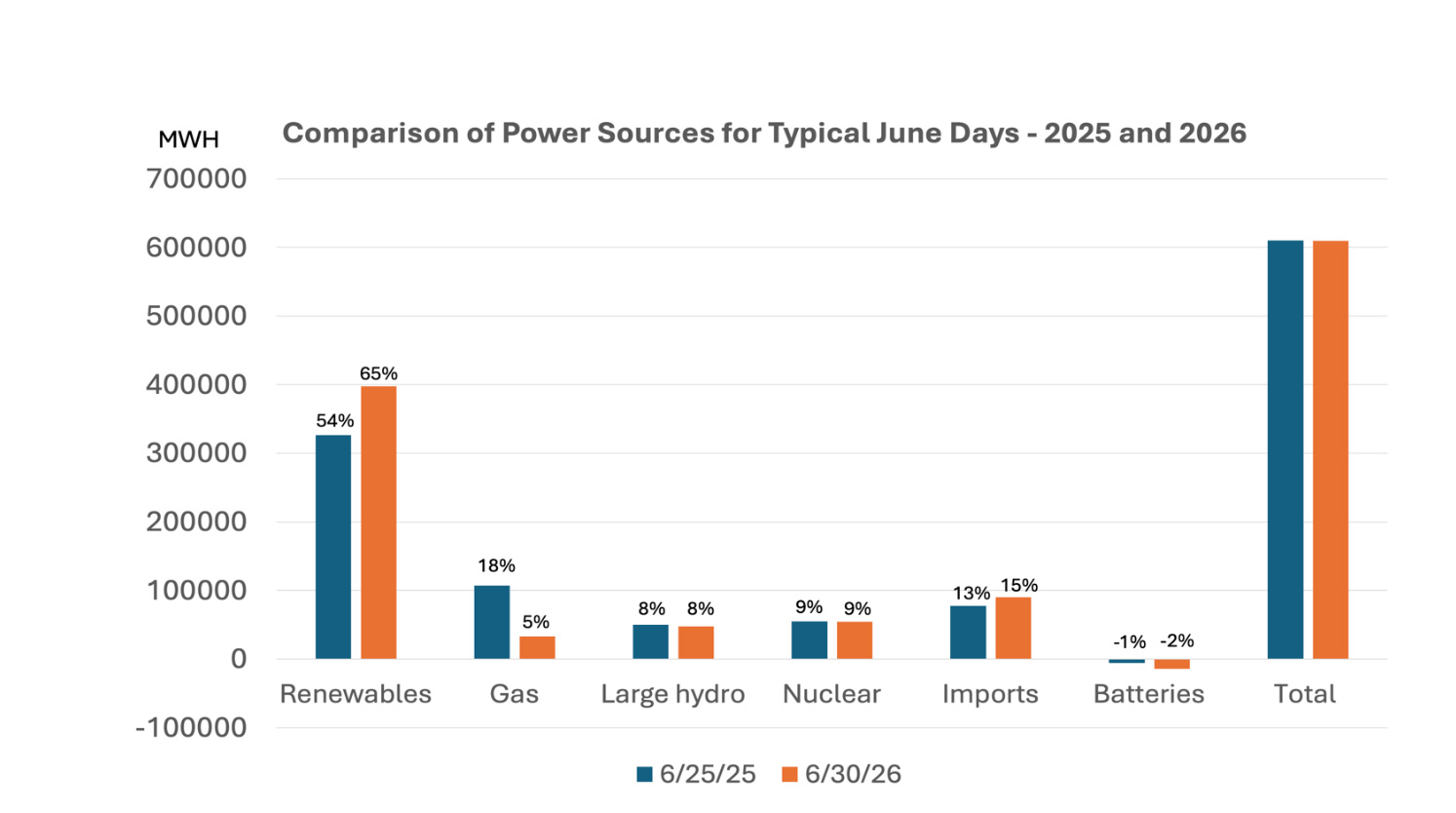
Chart 1 below compares the sources of power deployed on June 25, 2025 and on June 30, 2026. Gas-fired generation decreased dramatically from 18% of the daily energy output on June 25, 2025 to just 5% on June 30, 2026. Renewable generation increased from 54% in 2025 to 65% in 2026. Hydro and nuclear generation remained the same while imports increased slightly from 13% to 15%. Battery output is shown as a negative percentage in the chart that reflects the small losses from daily charging and discharging. The increase in losses between 2025 and 2026 reflects the growth in overall battery capacity.
Chart 1
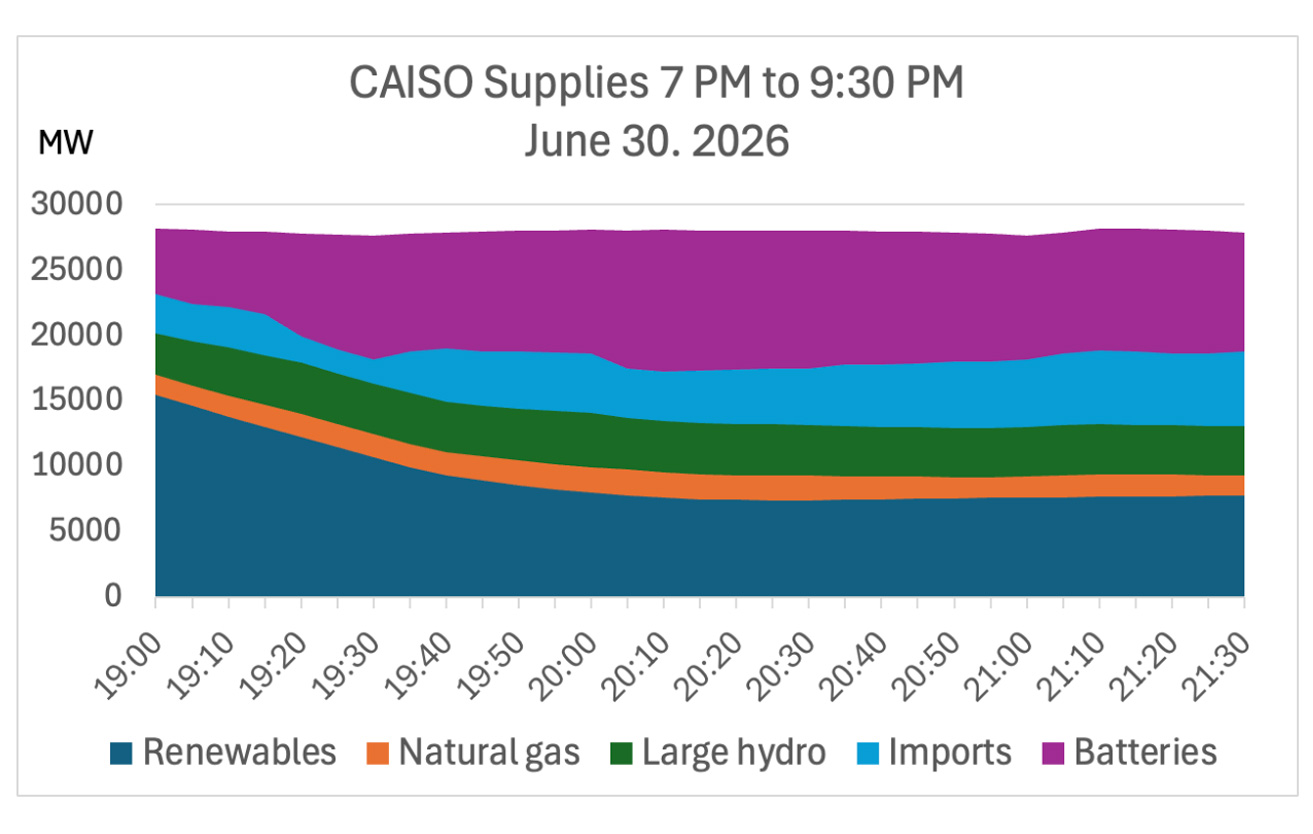
Charts 2 and 3 portray the resources (nuclear is removed for simplicity) used during the net peak period from 7:00 pm to 9:30 pm when the amount of energy required in California plateaus at a level slightly below the gross peak. This is the period of time when the sun sets with a sharp drop in solar energy while evening demand continues. What is most notable from the data for this time period is the amount of gas-fired power dispatched at the beginning and the end of this time period on June 25, 2025 and on June 30, 2026. Gas generation was replaced by battery discharging and wind generation during this two and a half hour period.
The table below shows the significant shift from gas generation to batteries discharging for the net peak ramp combined with a higher level of renewables (wind) at both the beginning and end of this time period. The category of renewable resources include solar photovoltaic, solar thermal, wind, geothermal, biomass and small hydro which corresponds to the definition used for implementing the renewable portfolio standard in California.
Comparison of Resources Used During the Net Peak Period in 2025 and 2026
| Day | June 25, 2025 | June 30, 2026 | ||
| Time | 7:00 PM | 9:30 PM | 7:00 PM | 9:30 PM |
| Gas | 6.8 GW | 7.4 GW | 1.5 GW | 1.5 GW |
| Battery Output | 5.7 GW | 7.9 GW | 5.0 GW | 9.1 GW |
| Renewables | 11.3 GW | 5.4 GW | 15.5 GW | 7.8 GW |
| Imports | 2.3 GW | 4.0 GW | 3.0 GW | 5.7 GW |
| Total | 26.1 GW | 24.7 GW | 25.0 GW | 24.1 GW |
The increased quantity of imports during the evening hours reflects the benefits of having more resources available in the day ahead market.
Chart 2
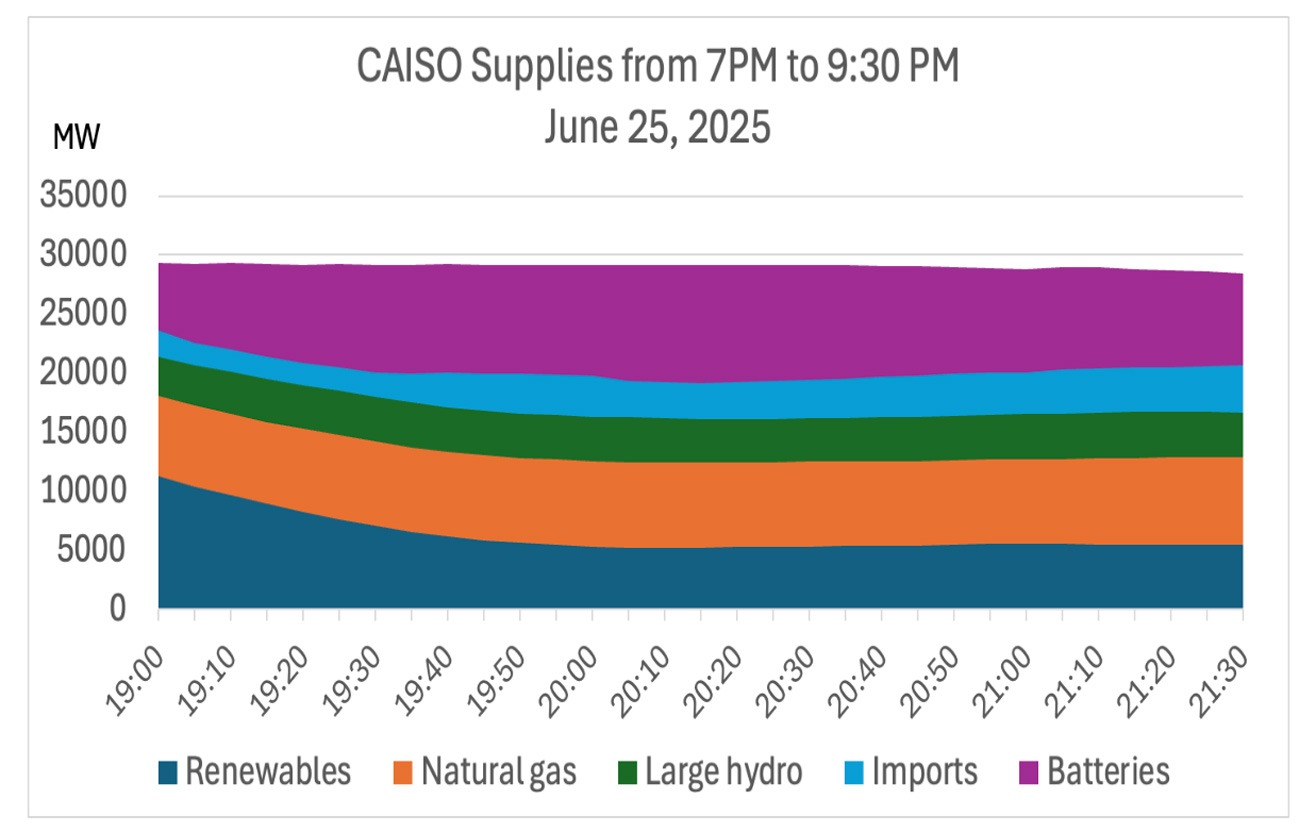
Chart 3
The two days selected for this analysis of the mix of dispatched resources represent normal early summer weather conditions. Peak demand was 32, 607 MW on June 25, 2025 and 30,232 MW on June 30, 2026. Daily energy consumption was almost equivalent with only a difference of 0.2% between the two days.
GridLab intends to take another look at the dispatch of resources under more stressful weather conditions which typically take place in August or early September. Last year peak demand reached 44,506 MW on August 21. The California Energy Commission forecasts a peak for 2026 in September of 46,844 MW.
EDAM will expand over the next 18 months to include Portland General Electric, the Balancing Area of Northern California, the Los Angeles Department of Water and Power, the Turlock Irrigation District and Public Service of New Mexico. The combined load of these balancing authorities will represent 42% of the load in the Western United States. These balancing authorities will further diversify the set of resources to be optimized in the day-ahead market.